Flutter Starlight — Cozy Game
- 4.7
- Rating
- 1.00M
- Installs
- Free
- Price

 Analysis by App-foxy
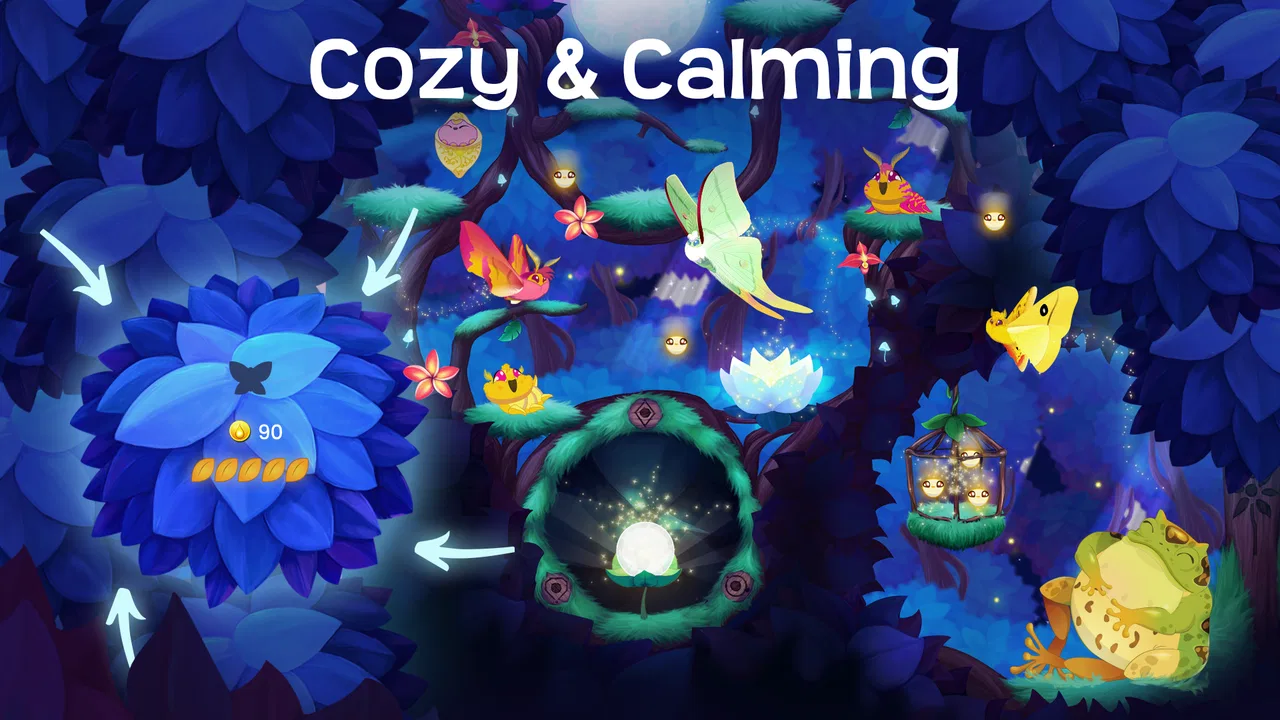
I found Flutter Starlight while looking for something gentler than the usual fast-paced mobile games, and its central idea is immediately appealing: collecting moths in a calm, cozy setting. Developed by Runaway Play, this free casual game is designed for short visits rather than demanding sessions. I can open it when I have a few quiet minutes, make some progress, and leave without feeling that I have missed an important competitive event.
That relaxed pace makes it interesting for a shared household device. One person can enjoy the collecting, another can simply explore the atmosphere, and younger players can understand the basic goal without needing a complicated tutorial. At the same time, it is important to treat it as a personal game rather than assuming that several people can safely share one progression path. The experience is most satisfying when each player has a clear turn and understands that their actions may affect the same in-game collection.
How the game feels in everyday use
The first thing I noticed is that Flutter Starlight does not try to overwhelm me with speed or constant pressure. Its moth-collecting theme gives the game a clear identity, while the cozy presentation encourages observation and patience. I would use it after work, during a short break, or before bed when I want interaction without the intensity of a racing game or a competitive multiplayer title.
You May Also Like

 Google Keep - Notes and lists
Google Keep’s Quiet Growth Shows the Appeal of Simpler Notes
As mobile work gets busier, Google Keep keeps winning a simple contest: capture a thought quickly, find it later, and get on with the day.

 Blood Strike: 2.5 Anniversary
Blood Strike’s Loadouts Turn Every Drop Into a Tactical Gamble
A close look at Blood Strike’s custom loadouts: how fast access to signature weapons reshapes its battle royale rhythm, rewards preparation, and narrows the gap between fights.

 Pandora - Music & Podcasts
Pandora’s Music Is Easy to Start, but Harder to Recover
Pandora’s strength is its low-effort path from a seed to a station. Its weak spot is how much confidence it asks you to place in connection, setup, and quiet recovery.

 8 Ball Pool
 Is Built on Rivalries, Rematches, and Routine
A close look at the rivalries, rematches, shared routines, and unanswered safety questions that turn a quick pool match into a persistent mobile community.

 Samsung Music
’s Quiet Strength Is Playing What You Already Own
Its reach comes less from spectacle than from dependable access to a personal library. That simplicity is both the app’s strongest retention engine and its ceiling.

 AccuWeather: Weather Radar
AccuWeather Review: A Quick, Clear Forecast for Everyday Decisions
For everyday plans, the best forecast is the one you can understand quickly. AccuWeather makes rain timing, radar, and local conditions easy to act on, with a few trade-offs.
More From Our News Desk



A realistic household example would be a tablet left in the living room. A parent might spend a few minutes collecting moths during a coffee break, then let a child take a turn later. That can work well if everyone agrees on what “a turn” means. The game is easy to approach, but a shared device does not automatically create separate player spaces. I would avoid handing it over casually if preserving a particular collection matters to more than one person.
The game’s strongest appeal is its mood. Many casual games use quick rewards, noisy effects, or increasingly urgent tasks to keep attention. Flutter Starlight feels better suited to someone who likes a slower loop, where the pleasure comes from building a collection and spending time in a pleasant setting. It is not the right choice if you want a deep strategy system, a story-heavy adventure, or constant action.
I also appreciate that the basic download is free, which makes trying it straightforward. The game is listed for Everyone, so it is broadly approachable from an age perspective. That label is useful as a starting point, but I would still look at how a particular child handles optional purchases and shared-device habits rather than treating the age category as a complete household recommendation.
What makes the collecting loop work
Collecting is a simple idea, but it gives the game a reason to bring me back without requiring long sessions. Instead of asking me to master complicated controls, the experience focuses attention on discovery and gradual completion. That makes it a good fit for players who enjoy organizing, noticing differences, and working toward a personal sense of progress.
My practical tip is to decide before playing whether the goal is relaxation or completion. If I approach every missing moth as something I must obtain immediately, the gentle atmosphere can turn into a checklist. When I treat the collection as a long-term project, the game feels much more comfortable. This is one of the less obvious trade-offs: the same collecting structure that creates calm can also encourage repeated checking for players who dislike leaving a set unfinished.
Compared with a typical match-three game, Flutter Starlight offers less emphasis on solving a new puzzle every minute. Compared with an idle game, it feels more personal because the subject is a collection rather than only a number increasing in the background. Compared with a competitive casual game, it removes much of the pressure to outperform another player. Those differences are valuable, but they also mean that anyone seeking constant mechanical challenge may find the pace too soft.
Sharing one device without confusing the experience
For household use, I would establish simple boundaries before anyone starts. The most useful rule is to decide whether the game belongs to one player or whether everyone is contributing to one shared collection. A shared collection can be enjoyable when the players like cooperating, but it can become frustrating if one person changes the progress another person was carefully building.
I would also agree on whether younger players can spend anything inside the game. The listed in-app purchase range runs from $0.99 to $99.99 per item, so the free entry point should not be mistaken for a completely cost-free experience. I would keep purchase decisions with the account holder and discuss them clearly, especially on a tablet or phone used by several people.
There is another boundary that is easy to overlook: a shared device can blur personal ownership. If one family member sees the moth collection as their project and another sees it as a communal toy, both may feel justified when they play. A short conversation solves more trouble than a complicated schedule. For children, I would explain that tapping through menus or spending resources can change the shared state even when the action looks harmless.
My preferred arrangement would be one primary player on the device, with occasional supervised turns for others. If the household wants a truly cooperative activity, everyone should agree that the collection is communal from the beginning. I would not promise separate progress or account boundaries unless the device and game setup visibly provide them; the safest approach is to work with the boundaries that are actually present instead of assuming that casual games include family profiles.
Coordinating turns and expectations
Flutter Starlight is well suited to short, informal turns because it does not demand the same kind of uninterrupted attention as a long story game. A player can sit down, enjoy a small piece of progress, and hand the device back. Still, “short” should be defined by the household, not guessed from the game’s calm presentation. A relaxing game can still become absorbing when someone is focused on completing a collection.
One useful routine is to let each player finish a clearly defined activity before passing the device. For example, a player might stop after reviewing the collection or completing the current small goal rather than handing it over in the middle of a decision. This reduces accidental taps and makes sharing feel fairer. It also helps younger players understand that cooperation is part of using the game together.
I would avoid turning the collection into a competition between family members unless everyone genuinely enjoys that arrangement. The game’s appeal is its peaceful collecting theme, and comparing who found more can introduce pressure that the design does not need. A better conversation is often, “Which moth did you enjoy finding?” rather than, “Who is ahead?” That keeps the shared-device experience aligned with the game’s cozy character.
Another practical point is timing. If one person plays just before another takes over, the second player may assume something has gone wrong when the environment or collection looks different. A quick verbal handoff helps: say what was changed, what remains to be explored, and whether any decisions are waiting. This is especially useful when a child is learning the game and may not yet understand which actions are reversible.
For adults sharing a phone, coordination matters for a different reason. A personal device often contains one person’s normal app-store account and payment setup. Since Flutter Starlight is free to start but includes optional purchases, I would not let another person browse freely on an account connected to a payment method. That is ordinary digital housekeeping, but it matters more when a calm game is placed within easy reach of several users.
Age, trust, and the free-to-play boundary
The Everyone rating makes Flutter Starlight easier to consider for a broad household audience. Its collecting premise is more approachable than a game built around combat, frightening scenes, or complicated online competition. I can imagine it working for a child who likes animals, nature-inspired themes, and gentle discovery, as well as for an adult who wants a low-pressure distraction.
Age suitability is not the same as purchase suitability. The presence of optional items means I would explain the difference between playing for free and choosing to buy something. For a child using a shared device, I would make the rule explicit: no purchase is made without asking. That conversation is more useful than simply saying the game is free, because it prepares the player for the point where the game may present an optional spending choice.
Trust also includes protecting each other’s progress. If a child is allowed to play independently, I would first show which parts of the interface represent the collection and which actions might alter it. I would let them explore under supervision before leaving the game available on a shared device. This is not because the core idea is difficult, but because a simple interface can make an important tap look like an ordinary one.
I would skip it for a household that wants strong separation between players and cannot tolerate shared progress. I would also choose another game for a child who needs a clearly competitive challenge, a structured educational objective, or a completely purchase-free environment. Flutter Starlight is a better match for trust-based sharing, calm routines, and players who agree about what the game is for.
Performance, platform expectations, and longevity
The game has been available since June 14, 2016, and its current version is 2.250. It supports devices running iOS 9 or later, which gives it a relatively broad compatibility window for older Apple hardware. That can be helpful in a household where a child receives an older phone or tablet, although actual comfort will still depend on the device’s condition and available storage.
Its popularity also suggests that the concept has reached well beyond a small experimental audience: the game has over one million installs, with an average rating of 4.7 from around 56 thousand ratings. I see those figures as reassuring signs that the basic idea connects with many players, but they should not replace personal fit. A highly rated cozy collection game can still feel too slow for someone who wants action or too repetitive for someone who needs constant novelty.
The developer, Runaway Play, has positioned this as a casual experience rather than a demanding premium title. That distinction helps set expectations. I would not approach it expecting the depth or uninterrupted polish of a large paid console-style game. Instead, I would judge it by whether the collecting loop gives me a pleasant reason to return and whether the optional spending remains easy for my household to manage.
One advantage of this format is flexibility. I do not need to reserve a long evening or learn a large control scheme before enjoying it. One disadvantage is that flexible games can become background habits rather than memorable activities. My advice is to play with a small personal goal, such as exploring a little or checking the collection, and then stop when the visit no longer feels relaxing. That keeps the game from becoming another obligation on the phone.
Who should install it, and who should pass
I would recommend Flutter Starlight to someone who likes gentle collecting, soft pacing, and games that can fit around ordinary life. It is especially suitable for a player who enjoys noticing gradual progress rather than chasing leaderboards. It can also work as a shared household game when the family agrees on ownership, turns, and purchase rules before handing over the device.
I would be more cautious with players who need a strong sense of mastery. There is no reason to choose this over a puzzle game if your favorite part of casual gaming is solving increasingly difficult boards. Likewise, an idle game may be a better option if you want progress that continues with very little interaction, while a social multiplayer title will suit you more if conversation and competition are the main attraction.
For parents, the decision comes down to supervision style. If you are comfortable explaining that a free game may still offer optional purchases and you can keep one collection from becoming a source of arguments, the game is easy to introduce. If you need independently protected profiles, strict built-in family separation, or a guaranteed no-spend setup, I would look elsewhere or keep it on an adult-controlled device.
For adults playing alone, the main question is whether the mood is enough. I enjoyed the idea of returning to a small, peaceful collection, but I would not claim that it replaces a larger adventure or strategy game. Its value is precisely its modesty. It gives me a quiet activity with a clear theme, not an elaborate world demanding hours of attention.
My household verdict
After spending time with it, I see Flutter Starlight as a friendly casual game whose best feature is the way it turns collecting into a calm, approachable routine. The moth theme gives it more personality than a generic reward loop, and the free starting point makes it easy to test on a compatible device. The broad age rating also makes it a reasonable candidate for a family conversation about shared play.
My reservation is not about the central idea; it is about boundaries. A shared device can make personal progress, purchase choices, and turn-taking less clear than they first appear. I would install it for one main player or create an explicit cooperative agreement before several people use the same collection. I would also treat the optional purchases seriously because the upper end of the listed range is substantial for an impulse decision.
My recommendation is simple: choose it for calm collecting, not for constant challenge. If you want a relaxing game that can occupy a few minutes and remain approachable for different ages, it is worth trying. If your household needs separate account spaces or your own taste leans toward action, complex strategy, or fully structured multiplayer, this will probably feel too limited.
In the right setting, the game works almost like a small shared ritual: one person explores, another checks the collection, and everyone respects the same boundaries. That is where I think it performs best. It does not need to be the most ambitious game on a phone to be useful; it only needs to make a quiet moment feel a little more enjoyable.
FAQs for Flutter Starlight — Cozy Game
01What is Flutter Starlight — Cozy Game about?
Flutter Starlight — Cozy Game is a relaxing nature-themed experience focused on discovering, caring for, and collecting beautiful moths in a peaceful nighttime world. Rather than emphasizing competition or difficult challenges, the game encourages slow exploration, decorating your surroundings, and enjoying gentle animations, soft music, and a calm atmosphere. It is designed for players who prefer cozy, low-pressure games that can be enjoyed in short sessions.
02Is Flutter Starlight — Cozy Game free to download and play?
The game can generally be downloaded without an upfront purchase, although the exact availability, pricing, and included content may vary between Android and iOS. As with many free cozy games, optional in-app purchases may be offered for decorative items, resources, or other extras. Before downloading, check the store listing and purchase settings on your device, especially if children will be playing, because optional transactions may affect the overall cost.
03Does Flutter Starlight require an internet connection?
Some parts of Flutter Starlight may be playable offline, which makes it suitable for relaxing during travel or when a stable connection is unavailable. However, online access can still be needed for features such as advertisements, cloud synchronization, special events, updates, or in-app purchases. The exact offline functionality may depend on the device and current version, so it is best to launch the game once while connected before relying on it without internet access.
04Is Flutter Starlight suitable for children and casual players?
Flutter Starlight is generally approachable for casual players because it does not rely on fast reflexes, complicated controls, or demanding combat. Its gentle presentation and collection-based gameplay can appeal to children, families, and adults looking for a peaceful experience. Parents should still review the age rating, privacy information, advertising, and in-app purchase options before installation, since these details can vary by platform and region.
05What devices are compatible with Flutter Starlight — Cozy Game?
Compatibility depends on the current Android or iOS requirements published in the official store listing. Most supported phones and tablets should run the game, but older devices may experience longer loading times, reduced performance, or limited visual effects. Make sure your device has enough free storage and uses an updated operating system. Checking the Google Play or App Store page before downloading is the safest way to confirm compatibility.
Pros
- Gentle gameplay is suitable for short
- relaxing sessions.
- Soft visuals and atmospheric lighting create a cozy mood.
- Simple controls make it accessible to casual players.
- Exploration feels calm without demanding fast reflexes.
- Works well as a low-pressure alternative to action games.
Cons
- Progress may feel slow for players seeking constant challenges.
- The relaxed pace can become repetitive over longer sessions.
- Limited action may not appeal to competitive gamers.
- Some areas may lack variety after extended play.
- A cozy atmosphere cannot replace deeper gameplay systems for everyone.

Flutter Starlight — Cozy Game
Gallery